Elizabeth Crowens Delights With Her Mystery Series Set in the Golden Age of Hollywood
As a huge fan of 1940s movies, it’s always a pleasure to interview Elizabeth Crowens:
 First off, congratulations on the release earlier this year of BYE BYE BLACKBIRD, the second book in your Babs Norman Golden Age of Hollywood Series. Can you share with our readers a bit about the novel?
In the summer of 1941, Hollywood heats up again when Humphrey Bogart arrives right after a female corpse with a dead bird stuffed inside her overcoat topples into the office of B. Norman Investigations. While filming The Maltese Falcon, Bogie found a mysterious ancient Egyptian hawk artifact on his doorstep containing a mummified black bird. Someone with dark intentions threatens the main cast, one by one, leaving dead birds, from crows to falcons, as their calling cards.
While more murders pile up, jeopardizing the film from being finished, Bogie hires private eyes Babs Norman and Guy Brandt, infuriating his volatile third wife, Mayo Methot, or Sluggy, as she’s known in some circles. Unraveling the personal lives of Mary Astor, John Huston, Sydney Greenstreet, Elisha Cook, Jr., Peter Lorre, and Jack L. Warner in their quirky, humorous way, the PIs turn the underbelly of Tinseltown upside down to stop the crazed killer from claiming another victim.
Just a heads up. Hounds of the Hollywood Baskervilles was more like a 1940s TCM screwball comedy. Bye Bye Blackbird has black humor but is much darker and more like a soft-boiled traditional mystery. (Don’t worry. It still keeps the “cozy sensitivity” toward swearing, sex and violence, and you will never see anyone killing a bird.) 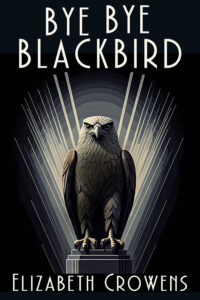
When I interviewed you about the first book in the series, HOUNDS OF THE HOLLYWOOD BASKERVILLES, you mentioned that the character of Babs Norman was inspired by your late best friend. Was Guy Brandt also inspired by someone you knew?
Guy Brandt is a fictional compilation of gay male actor best friends described from the interviews by the actual woman who inspired my Babs Norman character. In real life, “Babs Norman” was a drop-dead-gorgeous actress who had men constantly hounding after her for dates and trying to get her into the sack. She liked being treated to fancy dinners and getting gifts, but she hated being expected to put out in exchange. Therefore, she enjoyed cultivating friendships with gay male actors. They were fun to go shopping with and always gave great advice on how she should wear her hair or do her makeup, and she never felt pressured to do something she didn’t want to in their presence.
A related question: Can you tell us more about the personalities and backgrounds of both Babs and Guy, and how they’ve grown and changed since their first appearance in HOUNDS OF THE HOLLYWOOD BASKERVILLES?
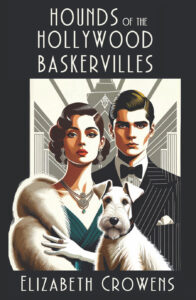
Hounds of the Hollywood Baskervilles entailed their first high-profile celebrity case. Previously, they had been struggling private eyes on small potatoes, run-of-the-mill assignments. Both were living hand-to-mouth. Babs was behind on her rent on both the office and her apartment and had to make a choice. She ended up getting evicted out of her residence and camped out in the office, until Basil Rathbone came along and hired her to find his missing dog. This, of course, led to Babs and Guy also getting hired by MGM to find Asta, who was also missing. He was the canine star of the Thin Man films, and MGM couldn’t start production on their next film without him.
By the time they solved the crime and retrieved the missing dogs in Hounds, they had gained the respect of the film community as competent private eyes. They got beyond their initial clumsiness of being young and awkward in the business.
In addition to your long and varied career in the entertainment industry, you have done extensive research on the Golden Age of Hollywood and feature many of its stars in your work. You mentioned in our first interview that you thought it would be “more difficult” for you to write a contemporary novel. Why do you think that is?
Before my Golden Age of Hollywood mystery series, I wrote three books in an alternate history, mixed genre (science fiction/fantasy/paranormal) series. Book one started out in 1899, and it involved time travel to all sorts of eras. For some reason, I naturally veer into the past. For me, if I wrote something contemporary, it would lean on the theory of “write what you know.” In my case, some of my worthwhile stories are a bit too painful to write about at the moment.
You call yourself a “serious plotter.” But in conceiving of your series, I’m wondering which came first, developing the characters of Babs and Guy, or plotting your work? Whereas I begin with a kernel of a premise and then focus on character before plotting, other authors have shared with me that they first come up with a plot and then “cast” the characters in it. I’m curious about your approach.
The character of Babs Norman came first. After that, I got heavy into plotting. Since Arthur Conan Doyle was a featured character in my Time Traveler Professor series, and I knew I was going to start my Babs Norman series around 1940 and in Hollywood, it only made sense to have Basil Rathbone be her first celebrity client. Besides, he was my first introduction to Sherlock Holmes. When I started bouncing around ideas about what kind of crime would be committed, I discovered in one of his biographies that he was a major animal lover, just like the “real Babs.” Dogs, in particular.
It didn’t take long to realize that wasn’t enough for a novel. I needed to have a celebrity dog disappear. That’s when kismet came into play, because The Thin Man played on Turner Classic Movies that evening. That’s when I included Myrna Loy and William Powell, two more screen detectives to assist the on-screen Sherlock Holmes. That’s also when I created Guy Brandt to be the Nick Powell to Babs’ alter ego of Nora Charles.
Since I had a three-book deal with level Best Books, I needed a lead-in to the sequel, Bye Bye Blackbird. Part of the research for Hounds comprised not only finding out the identity of other famous Hollywood movie dogs circa 1940 but also what kind of dogs other celebrities owned back then. Finally, I put two-and-two together. Not only did Humphrey Bogart love dogs and own several, but the following year he’d get his big break and would get cast as Sam Spade in The Maltese Falcon. I foreshadow the possibility of working with him toward the end of Hounds.
What is the best piece of writing advice that you ever received?
I must credit Steven James and the excerpt in his book, Story Trumps Structure, called The Ceiling Fan Effect. In a nutshell, and it’s worth buying the book just for this section, when you need to ramp up the tension, you have to ask yourself, “What can go wrong which will make the situation worse?”
What has been the most challenging aspect of writing your novels? And what have you discovered comes more easily for you?
The most challenging aspect is pulling away from the right-brained, creative writing process and switching to the left-brained marketing and promotions necessities. What works best for me is meeting other writers and readers in person at writing conventions. Unfortunately, that’s probably the least cost effective. I’m still trying to learn the magical combination.
What’s next for you writing-wise?
Two things. The third book in my Babs Norman series, Round Up the Unusual Suspects, centering around the production of Casablanca, will be out at the end of January 2026. Once again, you’ll see Humphrey Bogart and his third wife, Mayo Methot, (Lauren Bacall was his fourth wife, and they didn’t meet until 1944 in To Have and Have Not), Sydney Greenstreet and Peter Lorre from The Maltese Falcon. Beyond that, I’m playing around with a variety of projects, many of which involve my experience or knowledge of Hollywood.
Anything else you’d like to add, or wish I’d asked that I didn’t?
Sign up for my mailing list and receive a Best of the Caption Contests free eBook every month.
https://www.elizabethcrowens.com
You can find me on Facebook, X, Instagram, and Bluesky.
BIO
Elizabeth Crowens has worn many hats in the entertainment industry, contributed fiction and non-fiction to Black Belt, Sherlock Holmes Mystery Magazines, Hell’s Heart, and A New York State of Fright, and has a popular Caption Contest on Facebook.
Awards include: MWA-NY Chapter Leo B. Burstein Scholarship, NYFA grant, Eric Hoffer Award, Glimmer Train, Killer Nashville Claymore finalist, two Grand prize, and six First prize Chanticleer Awards. Crowens writes historical Hollywood mystery in Hounds of the Hollywood Baskervilles, Agatha nominee for Best First Mystery Novel and Bye Bye Blackbird. www.elizabethcrowens.com
Buy links:
Signed copies: https://www.larryedmunds.com/
David Kaye Books and Memorabilia +1 818 224 414
https://www.mysteriousbookshop.com/
Unsigned copies: https://www.amazon.com/Bye-Blackbird-Norman-Hollywood-Mystery/dp/1685128408
https://www.barnesandnoble.com/w/bye-bye-blackbird-elizabeth-crowens/1146771623
Fun read, Lynn and Elizabeth. Elizabeth, I think I signed up for your newsletter ( ;
Thanks, Pamela. I send out free digital copies of Best of the Caption Contests every month for subscribers.