Beyond Solving the Mystery: Elle Jauffret Explores Issues of Resilience and Identity in THREADS OF DECEPTION
In addition to the pleasure of learning more about wonderful authors and their works, I also love learning about things I’d never even known existed. In her debut mystery, Elle Jauffret features a character with a rare neurological condition, Foreign Accent Syndrome. Jauffret skillfully uses this condition as a way to explore issues of identity and the reactions of others to those perceived as “different.”
 First off, congratulations on your highly praised and award-winning debut mystery, THREADS OF DECEPTION. Can you share with our readers a bit about the novel and what inspired you to write it?
Thank you! Threads of Deception is the first in my Suddenly French mystery series. It follows Claire Fontaine, a former criminal defense attorney whose life is upended after a criminal explosion destroys her D.C. law firm, and leaves her with French Foreign Accent Syndrome (a rare neurological condition). With her legal career on hold and her bank account empty, she reinvents herself as a private chef. But when she returns to her California hometown to cater a fashion show, she finds the host and friend dead. The police think it’s suicide. Claire thinks otherwise. Drawing from her legal background (and armed with sharp knives and sharper wit), she investigates.
The story was inspired by real cases of Foreign Accent Syndrome and the societal reactions to people who speak differently (whether speech impediments, foreign or regional accents). As a French-born American who’s often been judged or underestimated because of my accent, I wanted to explore identity, voice, and belonging through the lens of a fast-paced, humorous, character-driven mystery.
I was fascinated that your character suffers from an unusual (French) Foreign Accent Syndrome. Where did you learn about this syndrome, and in what ways did it offer you an opportunity to challenge stereotypes and perceptions of identity, issues that go far beyond “solving the mystery”? 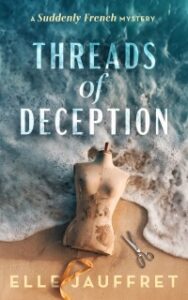
I first came across Foreign Accent Syndrome while researching speech disorders. The condition struck a personal chord: even though I’m actually French, I’ve experienced many of the same prejudices that FAS sufferers face—people assuming they are unintelligent, faking it, or not truly American. That gave me a strong emotional connection to Claire’s story.
FAS became a powerful metaphor in the book. It allowed me to explore how society reacts to “different,” how language and speech shape perception, and how voice (literal and metaphorical) can become both a barrier and a source of strength. Claire is often mistaken for a tourist and dismissed, even by law enforcement, despite her legal expertise. This tension added humor but also raised serious questions about assumptions and bias.
THREADS OF DECEPTION features a criminal attorney, Claire Fontaine, but it also involves Claire having experiences with fashion, food, and political campaigns. As a former attorney, you are very familiar with the legal aspects of your novel, but I’m curious about the kinds of personal experiences as well as research you did in order to dip into all these other worlds!
My legal background wasn’t directly useful in terms of procedures or courtroom scenes; it was more about the instinct it gave me. As a former criminal attorney for the California Attorney General’s Office, I often saw how the justice system could fail people. That gut reaction of wanting to protect individuals who might become victims of an imperfect system informed Claire’s character and her drive to do pro bono work. The legal issues she confronts in the book are inspired by ones I’ve personally faced, especially as a health-conscious parent navigating discrepancies between European and American consumer protections. I won’t spoil anything, but some of those conflicts are woven into the mystery.
As for the culinary side—that’s my world. I’ve always believed food is life. I cooked constantly for my children as part of their culinary education, and even catered a few events for friends. As a teenager, I worked a summer job for a high-end caterer and pâtissier on the French Riviera (Hollywood stars probably ate the bread I shaped). To this day, cooking remains one of my favorite ways to connect with people.
The political campaign elements came naturally. I went to law school in Washington, D.C., and lived in the area for many years. Politics are part of the air you breathe there. And fashion? That’s just a joy. Outfits are such a creative way to express personality. If it were up to me, I’d implement a mandatory “Dress Extravagantly Day” every month.
Your novel has been described as “character-driven drama.” In conceiving of your novel, did you begin with your characters and develop them, or did you focus first on developing your plot? Or was it a combination?
I started with Claire—her voice, her emotional journey, and the inner conflict of someone who’s been stripped of her identity and is trying to rebuild it. I knew I wanted to explore what happens when a capable, sharp woman suddenly isn’t seen or heard the same way because of something out of her control—her accent. Once I had Claire, I plotted her personal arc and the mystery separately, then carefully wove them together. I wanted the emotional beats and the investigation to unfold in tandem, each influencing the other. For me, the most satisfying mysteries are the ones where solving the case also reveals something deeper about the protagonist.
Tell us more about your writing process. Do you consider yourself more of a pantser, planner, or somewhere in-between?
Definitely somewhere in-between. I’m a planner—with a twist. I think about the story in my head for a long time before writing anything down. Once I’m ready, I sit down and write the entire story in one sitting. I write down the key plot points, clues, and evidence across about 15 to 20 single-spaced pages. That document becomes the foundation of my outline. From there, I break it into sections and chapters, adjusting as I go. It gives me a clear roadmap but still gives me flexibility during the writing process (often a character will surprise me or take the story in an unexpected direction, and I allow that to happen).
Prior to publishing your novel, you published many short fiction pieces. What was the transition like to creating a novel?
I’ve always written both. For me, short stories and novels require different muscles. Short stories are actually more challenging in some ways because you have to capture an entire story and character arc in very few words. But they’re also more immediately satisfying since you can finish one in days instead of months. Novels, on the other hand, feel more natural to me because I tend to write layered, complex stories, and short stories don’t always allow room for multiple subplots. I also like alternating formats. After finishing a novel or when I struggle to write, I usually write a short story to reset my creative rhythm.
You have also written fiction for middle grade and teen readers. What have you found to be the similarities and differences between writing for adults versus young people?
The core of storytelling is the same for both adult and children’s writing. It’s about character development, emotional arcs, and a compelling plot. However, writing for younger readers comes with more structure and responsibility. There are clearer guidelines (safeguards) regarding language, content, and themes. You have to be mindful of age-appropriate vocabulary, limit violence and certain topics, and ensure that your story ultimately offers hope—or at least the possibility of a solution. Children’s books should never leave readers in despair. That’s a key difference: young readers need emotional safety nets, while adult fiction gives you more freedom to explore ambiguity, darker themes, and moral complexity. Writing for adults is liberating in that way, but both require the same commitment to honesty and emotional truth.
What is the best piece of writing advice that you ever received?
“Amateurs sit and wait for inspiration. The rest of us just get up and go to work.” That’s from Stephen King’s On Writing, which I consider my creative bible. The best advice I’ve ever received (and lived by) is to show up for your writing, every day if possible, and treat it like a job. Talent matters, but discipline matters more.
What’s next for you writing-wise? 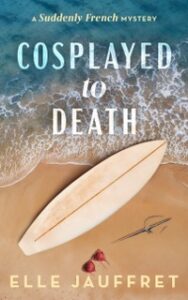
Cosplayed to Death, the second novel in the Suddenly French mystery series, comes out on November 12, 2025. In this book, Claire steps into the colorful, high-energy worlds of cosplay and competitive surfing in San Diego County. The mystery delves into how we present ourselves to the world, how appearance, image, and performance shape perception, and what happens when those images clash with reality.
Each novel in the series explores a different facet of identity. The first book, Threads of Deception, centered on voice and belonging, how the way we sound can affect whether we’re seen as “insiders” or “outsiders.” Cosplayed to Death examines who we are on the surface, and how much of that is real versus crafted.
I’m also currently drafting the third book which takes place around Halloween. It explores the ghost of our past (both personal and societal) and unravels the long-buried mystery of Claire’s sister’s disappearance. This installment also takes a hard look at how certain outdated or unjust laws have shaped people’s lives in ways. It’s ultimately a story about accountability, both personal and systemic, and what it takes to confront the truth and move forward.
Anything else you’d like to add, or wish I’d asked that I didn’t?
Maybe just this: Threads of Deception is a mystery, yes, but at its heart, it’s about resilience and identity. If you’ve ever felt underestimated, dismissed, or like an outsider in your own country, I hope this book resonates with you. Claire’s journey is about finding her voice (literally and figuratively) and learning to stand tall in a world that keeps trying to define her.
Also, for readers who enjoy the culinary side of the series, I’m working on a free digital cookbook inspired by the Suddenly French mysteries. It’ll be available soon on my website. And for book clubs, I offer a free downloadable discussion guide, and (schedule permitting) I’m happy to join your group for a complimentary Zoom visit. You can find all of that at ellejauffret.com.
*******************
Bio:
Elle Jauffret is a French-born American lawyer, former criminal attorney for the California Attorney General’s Office, and culinary enthusiast. She writes cinematic, character-driven mysteries that blend suspense, identity, and social themes. Her debut novel, Threads of Deception, is the first in the Suddenly French mystery series. Elle lives in Southern California and is a member of Mystery Writers of America, Sisters in Crime, and International Thriller Writers.
Buy Link:
Threads of Deception – Available wherever books are sold, including:
https://www.ellejauffret.com/Books
(links to Target, Amazon, B&N, etc.)
Contact / Website:
https://www.ellejauffret.com
https://ellejauffret.com/Contact
Instagram: https://www.instagram.com/ellejauffret/
Facebook: https://www.facebook.com/elle.jauffret
Linkedin: https://www.linkedin.com/in/ellejauffret/
Thanks, Lynn and Elle. There was some advice in here that I think I really needed to hear. It’s sort of the other side of the write-what-won’t-leave-you-alone approach ( ;
“Amateurs sit and wait for inspiration. The rest of us just get up and go to work.” That’s from Stephen King’s On Writing, which I consider my creative bible. The best advice I’ve ever received (and lived by) is to show up for your writing, every day if possible, and treat it like a job. Talent matters, but discipline matters more.
I so agree, Pam. It’s funny, but there are days when I really don’t feel like writing. And yet, those are the days when I make myself write because it is my job. When I look at the work, I can’t tell the difference between when I was fired up to write or when I had to drag myself to my desk!
I’m glad the interview resonated with you. Lynn asked fantastic questions. Discipline is really what turns ideas into finished stories. It’s like working out: consistency is key to build strong (mental/creative) muscles.