Millicent Eidson Talks About Point of View and Her Medical Thriller Series
Having recently done a presentation on point of view for my local Sisters in Crime chapter, I was delighted when Dr. Millicent Eidson expressed interest in writing a guest blog on POV and how it relates to reader identification with complex characters. For an introduction to Millie, I’d love for you to take a look at my previous blog, Medical Mysteries with a Twist: Meet Veterinarian-Turned-Author Millicent Eidson – Lynn Slaughter. As an indie author, Millie has released five of her alphabetical medical thriller novels.
How Point of View Shapes Character—and a Medical Thriller Series
by
Millicent Eidson
 Point of view is one of the most powerful—and most underestimated—choices a writer makes. It’s the lens through which readers experience a story, and the wrong lens can blur everything. When I started writing my MayaVerse medical thrillers, I didn’t realize how much POV would shape not just the books, but my characters themselves.
For Anthracis: A Microbial Mystery—the series opener about anthrax—I chose a close third‑person POV for Dr. Maya Maguire, my main character. I wanted readers not just to follow her, but to feel the urgency that drives a young American veterinary epidemiologist determined to protect human lives from zoonotic diseases (those from animals). Adopted as an infant from China, Maya is pulled between a longing for connection and a deepening awareness of how human behavior, other animals, and the environment fuel outbreaks. That intimate lens lets readers experience her professional mission and personal vulnerabilities side by side.
By the time I reached the second MayaVerse novel, centered on the bacteria Borrelia, I realized how much I enjoyed the intimacy of a single close third‑person lens. Keeping the focus entirely on Maya let me explore her growth as she navigated outbreaks abroad—and it also opened the door to new characters who would eventually demand their own narrative space. That’s where Dr. Stefan Duda enters the picture, a Polish WHO physician whose dedication to global health strains the home life he shares with his partner, Kondrat, and their daughter in Norway. At this stage, though, he remained just outside the POV spotlight, waiting his turn.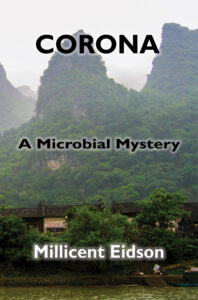
Maya’s mentors have always been the backbone of the series, but in the third novel—my Corona story—they step forward in a bigger way. Dr. Fred Grinwold, the gruff physician who has spent decades chasing pathogens across New Mexico, and Dr. Nancy Bingham, his equally committed partner in Arizona, both shape Maya’s worldview. They don’t get POV chapters in this novel, but their voices echo through the story. Readers who want to see the world through their eyes can find their prequel tales in Microbial Mysteries: A Story Collection. 
Novel #4, centered on Dengue virus, finally cracks open the perspective of one of Maya’s strongest influences: Dr. Faye Simpson, New York City’s nearly‑retired public health veterinarian. Giving Faye her own POV felt like handing the mic to someone who had been waiting impatiently in the wings. Her chapters explore not only the outbreak in Hawai‘i but also her relationship with Taylor Lewis, a much younger trans female physician whose presence challenges Faye to rethink what she wants from the next chapter of her life.
Then came the big leap. Inspired by the kaleidoscopic POV structure in Crichton and Patterson’s Eruption, I let myself go bold in novel #5, my Ebola story. Six POV characters. Six emotional arcs. Six windows into a crisis that spans continents. Maya, Stefan, Faye, and Taylor all take center stage, but the story also widens to include Mark Zielinski—Maya’s friend‑turned‑lover—and Biko Okeke, a young Nigerian community health physician whose world is upended by the outbreak. Writing this book felt like conducting an orchestra: every voice distinct, every perspective essential. 
After the exhilarating chaos of juggling six perspectives, novel #6—focused on Fasciola, a liver parasite—felt like a return to intimacy. I narrowed the lens to Maya, Faye, and Stefan, giving each of them more room to breathe. The story is now in final edits for an early‑summer release, and the tighter POV structure has been a refreshing return to a more intimate focus on Maya.
Writers are often told to pick a POV and stick with it across a series. I’ve never found that advice particularly useful. Characters evolve, stories expand, and sometimes the narrative simply demands a new angle. Experimenting with POV has kept the MayaVerse fresh for me—and, based on reader feedback, for my audience as well. Short stories have been my playground for even wilder experiments, from first person to second person to full omniscient.
I’m always curious how other writers navigate this. Do you stay loyal to one POV, or do you let the story decide whose eyes we see through? And as a reader, what makes you lean in—or pull back—when a book shifts perspective?
BIO:
Dr. Eidson’s work as a public health veterinarian and epidemiologist began with the Centers for Disease Control and Prevention and continued at the New Mexico and New York state health departments. She is a public health faculty member at the University at Albany and the University of Vermont, and the author of over a hundred scientific papers, articles, and book chapters.
SOCIAL MEDIA LINKS:
WEBSITE: HOME (drmayamaguire.com)
FACEBOOK: Maya Maguire Media | Facebook
LINKEDIN: Millicent Eidson | LinkedIn
INSTAGRAM: Millie Eidson (@drmayamaguire) • Instagram photos and videos
SUBSTACK: https://substack.com/@millicenteidsonauthor
BOOKBUB PROFILE: Millicent Eidson Books – BookBub
AMAZON AUTHOR PAGE: Amazon.com: Millicent Eidson: Books, Biography, Blog, Audiobooks, Kindle
GOODREADS: Millicent Eidson (Author of Anthracis) | Goodreads
YOUTUBE: The Power of the Dog: Confused by the Surprise Twist Ending? – YouTube
BUY LINKS: https://books2read.com/millicenteidson/
This made me think, perhaps to dream… A deep dive into POV evolutions within a series. Very well done. Thank you, Millicent and Lynn.
Thanks, Pam! When I first started writing, I didn’t think a lot about POV. Now I realize just what a major decision it is for us as writers.
Pamela, yes–POV is such a complicated subject with so many options. Initially I thought I needed to maintain the exact POV throughout the entire series. Exploring POV variations through short stories gave me initial confidence in expanding it. I don’t think I’d get away with switching entirely to 1st person in the series, although I try that through a diary. But having multiple characters’ POV, without head hopping, was a fun challenge.