A Genuine Love for Writing: Meet Horror Author Vic Kerry
One of my favorite parts of earning my MFA in Writing Popular Fiction was being exposed to wonderful writers working in genres so different from my own. I learned that good writing is good writing, and today, I’m delighted to feature horror writer Vic Kerry, another Seton Hill University alum.
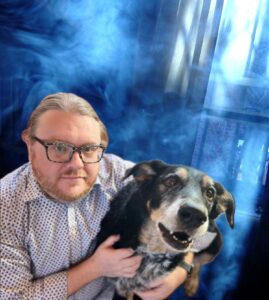 You are the published author of several books, but I know you’re especially eager to talk about your middle grade novel. Can you share with our readers a bit about the novel and what inspired it?
For The Thirteenth Halloween, I was actually writing a short story for an open call. It was about a couple of kids taking their last trick or treat. I liked the short story so much that I decided to expand it into a middle grade novel. To flesh it out longer, I drew inspiration from the Hansel and Gretel fairytale.
What drew you to writing horror?
I’m not going to say that I’ve always liked horror because I haven’t, but I’ve always liked monsters. When I wrote my first story in the third grade, it was a horror story about ghosts that ate people’s heads. Although I’ve written lots of different stuff since that time, I was drawn back to horror in the early 2000’s. I find that horror allows me to be creative and imaginative in a way that other genres don’t. While writing The Thirteenth Halloween, I found that MG horror let my imagination run even freer.
There is also the fact that I’ve spent most of my adult life working in the high stress environment of psychiatric units or something similar. In that work setting, you are exposed to the darker side of life. If you don’t let that darkness out, it will destroy you. Horror has been my pressure valve.
Were there particular authors and books that inspired you? 
I was not a R.L. Stine kid. I was too old for Goosebumps. I did watch Scooby Doo and The Real Ghostbusters as a kid. Once I got older, I read the classics. My first encounter with Frankenstein was too early on, and I missed the pathos of the work. Robert Louis Stevenson’s The Strange Case of Doctor Jekyll and Mr. Hyde drew me in as did “The Legend of Sleepy Hollow” by Washington Irving. As a young writer, Edgar Allan Poe’s stories were an inspiration. I also loved Ray Bradbury’s work, especially Dandelion Wine, which isn’t horror, but does have that wonderful subplot of the Lonely One. Even now when I read Bradbury, his wordsmithing fills me with an energy to get up and write. As an adult, I really liked the works of Jack Ketchum as well. When I thought up the idea to make the short story that became The Thirteenth Halloween, I decided that I needed to research some MG horror. The school I worked at happened to be having a Scholastic Book Fair. I picked up K.R. Alexander’s Scare Me. I really liked it and have read most of the books in that series. I guess he might be an inspiration at least for MG writing.
Did you always know that you wanted to write, and when did you decide to seriously pursue writing novels?
Growing up, I wanted to be a cartoonist. Then one day, I realized that I couldn’t draw. After that, I started writing. It was a way of getting stuff out of my imagination. As I mentioned previously, my first story was in the third grade. I steadily wrote from that point on. In the sixth grade, I wrote Star Wars parodies using classmates as characters. In the seventh grade, I wrote Clue knockoffs, again with friends as characters. I moved on to writing some comedy stories. I came back to writing dark fiction through high school.
I suppose the first novella I wrote was in graduate school in 2002ish. I had pursued writing YA fiction up to that point with no results. The novella was still YA but was definitely horror. I have since cannibalized that work putting elements into other stories. I published my first short story in 2007. My first real attempt at a novel came when I started the MFA program at Seton Hill.
You spent 12 years as a psychotherapist and left to become a junior high English teacher. What led to that decision?
I can tell you’ve done your homework. I can also tell that I need to update my biography. I have since gone back to being a psychotherapist and director of a psychiatric step-down unit, but I can answer this question anyway.
After 12 years of working as an inpatient psychotherapist, something had to give. Working inpatient is like working outpatient on a double dose of steroids. I was burned out. There was nothing left but apathy, and apathy does not a good therapist make. I became a teacher because one of my favorite parts of being a therapist was doing education group therapy. I got certified to teach English. I went to junior high because there aren’t a lot of men who voluntarily go there. I was hedging my bets to get a job. I enjoyed teaching and the school I worked at. I left that school to help care for my mother who was living with us. She has dementia. Two weeks after school started, she went into a nursing home, so I didn’t really need to leave the school I loved.
I began working at the school in my hometown. It’s also where I went to school, so you know everybody, and everybody knows you. This school was not like the first one I worked for. It had bad vibes from the start. One afternoon a parent showed up on my doorstep wanting to fist fight because I had dealt with their student’s discipline issue. When I wouldn’t fight him, he rabble-roused. This ended up with parents showing up at school complaining about me being allowed to teach because I wrote horror novels. (I do not promote myself to my students, and I write under a pen name to protect myself. I was and am very open about what I write in job interviews. It didn’t matter.) They were so disruptive that I was sent home for my safety and the safety of the students. I later found out that some of these parents were rolling on the floor screaming that they were terrified of me. To my knowledge, I had never met these people. I was called into the superintendent’s office and told because I was not tenured that I was being asked to resign, which I gladly did. I didn’t need the hassle. Less than a week later, I was a psychotherapist again with my old company but in the new position as director of the crisis residential unit with a raise. So . . . I’m back where I started and probably where I belong. I have 20 years of knowledge of psychiatric issues that were just going to waste teaching English.
Have you drawn extensively on your experiences both as a therapist and junior high teacher in your writing?
There have been many things that inspired either whole stories or bits and pieces of stories from my time in the world of psychiatric treatment. My first novel was based on the idea of what I would do if a cult kidnapped me while I was going out to see clients in their homes.
My first published short story, “Blue Day,” was inspired by my time as an outpatient therapist. It started off as a what if? What if I had a client come in telling me that he was bitten by a zombie? What would I do? My answer was commit him. What if he really was bitten by a zombie? I’d die.
I’ve not really drawn much from my time as a teacher. I picked up how kids talked nowadays, so I incorporated that into my MG work.
One thing that I have found is if I try to write mental illness as it really is, I’m told that it is “unrealistic.” People prefer the mental illness they see on TV and movies that is full of inaccuracies as opposed to the real deal.
You earned your MFA in Writing Popular Fiction from Seton Hill University. Was that an important part of your growth and development as a writer?
Seton Hill is the reason I am a published novelist. I can hands down say that I would never have been published had I not gone through that program. My first novel, The Children of Lot, was my master’s thesis in the program. Working with the faculty and the students helped me learn better writing skills. When I make a boneheaded move writing, I can see my critique partner in my head telling me to do it the other way.
I don’t think everyone needs an MFA in creative writing, but I think everyone who is going to write needs to take a class in writing. It teaches you so very much. Although I’m still paying off that student loan, it was worth it.
What is your writing process like? Are you a seat-of-the-pants writer, a planner, or somewhere in-between?
Pantser– 100%. I’ll get inspired by something. I’ll let that idea germinate in my mind for a little while. I’ll do some research if I need to, and then when the time is write, I plant my butt in my office chair and I start.
Once I start writing a novel or novella, I try to work every day on it with the goal of writing a chapter at a time. My rule of thumb for a chapter is 1,500 words or more. If I’m having a good day, I might do two chapters in a sitting. Toward the end of a work, I might write 5,000+ words in a day. It’s all about getting hit with inspiration.
Short stories I try to write in one sitting or at the most two.
I will say that since I’ve started my job as director of CRU, my writing routine is off a bit. I now mostly write on the weekends because I’m tired of sitting at a computer by the time I get home in the afternoon.
Having been a teacher, I know it’s a career that involves many, many hours on the job. How did you manage to find time to write?
My last full year teaching, I actually had two creative writing courses, an eighth grade class and high school class. I wrote while the kids did. I had more time to write as a teacher than I currently do as a director of the psych facility. Right now my writing is confined mostly to weekends.
What are you currently working on?
This is one of those times when I have a ton of ideas. I just finished writing another middle grade novel which I’m letting sit for a few weeks before I start second drafting it.
I don’t go into details of books that I am in the planning process or in the middle of writing. I consider it bad luck.
Anything else you’d like to add, or wish I’d asked that I didn’t?
I don’t think there’s anything much to add. I will say that I love writing. If I never published another thing, I’d keep writing simply because I love the process of it. Even writing the answers to these questions was satisfying to me. I hope that readers will check out my books, and please leave reviews. As readers, the best thing you really can do for a writer, is to leave a review.
BIO
Vic Kerry is the author of five novels, two novellas, and a collection of short stories, all in the horror genre. As V.M. Kerry, he published his first middle-grade horror book called The Thirteenth Halloween. Kerry won the 2022 Next Generation Indie Book Award for Novella. He also won first place in the 2022 Alabama Writer’s Cooperative Writing Contest for flash fiction. He placed second in the AWC flash fiction contest in 2021 and in AWC’s short story competition in 2024. He lives in Alabama with his wife, dog (Penny Dreadful), and cat (Hercules).
Amazon.com: Vic Kerry: books, biography, latest update
Amazon.com: V.M. Kerry: books, biography, latest update