A Conversation with Harini Nagendra About Her Richly Layered Bangalore Detective Club Mystery Series
What a joy to interview someone as thoughtful and incisive about her work and her writing process as Harini Nagendra!
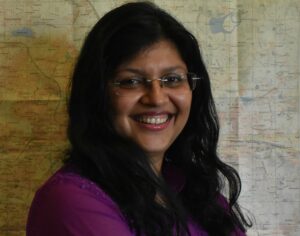 First off, congratulations on the publication of your fourth Bangalore Detectives Club Mystery, INTO THE LEOPARD’S DEN. Can you share with our readers a bit about the novel and the series as a whole?
Thank you Lynn! I’m delighted to bring book 4 out into the world. The Bangalore Detectives Club is a series set in 1920s India – in the backdrop of the nascent fight for suffrage, issues of women’s empowerment, and the Indian independence movement.
In Into the Leopard’s Den, amateur detective Kaveri Murthy returns with her most complex case yet: investigating a series of murders that take her from the bungalows of Bangalore to the mist-enshrouded mountains of Coorg.
It’s Bangalore, 1922. Pregnant and confined to the house by her protective mother-in-law, Kaveri Murthy has resolved to take a break from detection. But when an elderly woman is murdered at night, after asking for Kaveri’s help – how can she refuse? Kaveri investigates her new case, finding a trail of secrets that leads her to suspect the killer may be in Coorg.
Eager to be reunited with her husband who is working there, Kaveri sets off to Coorg, but encounters a thorny thicket of cases when she arrives. Why does a ghost leopard prowl the forests at night? And who is trying to kill Colonel Boyd, the Coffee King of Coorg? She finds suspects in every coffee bush and estate – from Boyd’s surly plantation manager and security guard to the feuding brothers who own the neighbouring plantation and the many women the Coffee King has pursued and abandoned. 
When two vulnerable children appeal for her help, Kaveri is drawn deeper into the case, becoming emotionally involved in finding the killer. Soon, one murder turns into two – and then a few days later into three. Now the killer has tasted blood and needs to be stopped. In this stunning new novel by an acclaimed master of the form, the Bangalore Detectives Club must find and expose a brutally intelligent killer before they strike again.
Tell us about your protagonist, Kaveri Murthy. What is her background and personality like? And how has she changed and grown during the course of the series?
At the beginning of the series, in the first book – The Bangalore Detectives Club – Kaveri Murthy is a young, 19-year old new bride who has just moved to Bangalore, to live with her husband – Dr. Rama Murthy – and her mother-in-law Bhargavi. It’s an arranged marriage, and Kaveri – who loves mathematics, swimming in a sari, and driving her husband’s beloved Ford across the city – is also learning how to adjust to being the only daughter-in-law in a prominent wealthy family, where her husband is supportive of her aspirations, but her mother-in-law expects her to stay at home, learn how to cook and manage the household, and set aside her educational aspirations. Along the way, she connects to a motley crew of individuals across the city – including Uma aunty, her inquisitive neighbour; Mala, a young woman who was forced into prostitution; Venu, a young milk delivery boy; and supportive Inspector Ismail. Together with Kaveri and Ramu, these individuals create the informal Bangalore Detectives Club, dedicated to solving crime and restoring justice across the city.
In book 2, Kaveri – now more confident in her skin, after solving a series of challenging murders – sets herself to mending the previously fractured relationship with her mother-in-law, by helping her cousin who suffers a tragic loss when her husband is brutally murdered. Bhargavi is getting drawn into the sphere of influence of a charismatic religious leader, and Kaveri and Ramu must help her free herself from being pulled into a cult, while solving a set of murders and helping Anandi, a young woman working as a housemaid, to escape from an abusive marriage.
In book 3, Kaveri and Ramu attend a magic show, only to find the master magician abruptly disappear from stage. When his son appeals to Kaveri for help, she finds that the answers lie in the secret gatherings of the independence activists. In books 2 and 3, Kaveri grows more comfortable in her own skin, and less naïve, more reflective, as she gets more comfortable with the underbelly of human society, and learns how to interpret who is on the side of the right, while righting grievous wrongs. At the end of book 3, pregnant Kaveri is excited about the prospect of being a new mother, yet worried about how she will balance the demands of motherhood, detection, and her desire to study advanced science.
In book 4, which takes Kaveri outside Bangalore to the coffee-clad mountains of Coorg, in her most complex case yet – she grows closer to her husband, while coming to terms with the changes in her personal life. At the same time, she also becomes more confident that her supportive and loving family will help her balance the various aspects of her life.
You have such a rich cast of recurring secondary characters who assist Kaveri. Can you share a little about how you developed these colorful characters? I’m also curious as to whether you tend to focus on character development first or plotting your novels, or some combination thereof.
I was clear from the start that I didn’t plan on writing the traditional ‘Hero’s Journey’ with one main protagonist who solves the day through her efforts alone. In real life, the best things are done by groups and collectives, not by individuals alone. I believe in the power of collective action and focus on it in my research – I wanted to bring this into my fiction as well. My books are therefore very centred around the idea of the Club i.e. a group of amateur detectives who solve mysteries. Some of these characters were central to my original vision, like Ramu, Kaveri and Venu – others, like Uma aunty and Inspector Ismail, walked onto the page and took over in ways I had not anticipated when I began writing the first book. I try not to control the process too tightly – if I question my subconscious, I find that my writing doesn’t go as well as if I just let the writing emerge.
My books are character-driven, and I tend to begin by throwing my protagonists together on a page and observing the plot threads that evolve – and then going on a long walk to think about how I could weave these into an interesting story. While I do have a few potential plot threads and twists in mind when I begin writing, they don’t always work as planned – often my characters decide to go in different directions from what I had originally planned for them.
Over the course of writing 4 books, while now working on the 5th, I have developed a loose strategy that seems to work for me – at least this far. I plunge into a long outline which starts with an elaborate version of chapter 1, and then becomes abbreviated as I go along, with the last half of the book usually being outlined in a page or two. The outline can be anywhere from 5-20 pages long. Once I have this, I begin writing – but as I go, and the characters begin to walk away from the plot in different directions, I return to the outline and make changes to it. Sometimes, new characters appear on the page – at other times, some characters act wooden and don’t work as I had envisaged, so I discard them. I do want a coherent plot where all the threads come together, but that often happens only after my second draft. That said, I try not to go back and edit too much as I write, or I’ll never finish the first draft. Instead, I add a couple of sentences to each completed chapter with notes like “X doesn’t go to the church, she goes to the fete instead, and stumbles upon A blackmailing B”, just so that I don’t forget what I need to fix in revisions.
You are an ecologist and a professor with numerous scientific publications. What drew you to writing a historical mystery series as well?
Before I wrote non-fiction, I was always a fiction writer – from when I was about 6 years old, and could dictate sentences to my scribe (my older sister). I’ve always loved historical mysteries, but hadn’t ever thought I could write one myself. Sometime in March 2007, when I was buried in historical archives for a non-fiction book project on the ecological history of Bangalore, Kaveri Murthy parachuted into my head, demanding that I write a book about her. It took me till 2022 to publish the book – mainly because I’m not a plotter, and I had to rewrite the plot of the first book three times from scratch before I was happy with the conclusion. But once I knew that Kaveri was to be my protagonist, I was clear that I would write a mystery series – that’s the kind of book I love reading the most myself.
In what ways have you integrated your expertise in ecology into your fiction?
My books are strongly place-based, and setting takes the form of a character in my books, woven like the weft within the warp of the main storyline. Ecology forms an integral part of the setting for me. Whether it’s the trees and lakes of Bangalore, or the colonial influence in planting exotic species from across the world; whether it’s talking about cowherds grazing their cattle, or wrestlers practicing in the shade of a wooded grove; weaving in the story of Kaveri and Ramu visiting a botanical garden and stumbling across a suspect acting strangely, or recipes that use fresh curry leaves plucked from the garden – ecology is everywhere in my stories.
Into the Leopard’s Den is the most ecological of the books in the series. Set in Coorg, the book delves into themes close to my heart as an ecologist – the ghost leopard is a nod to human-wildlife conflict issues that began in British times; the stories of wild animal hunts are drawn from real-life ‘exploits’ of British big game hunters; and the history of capitalist devastation of tropical South Indian forests to produce coffee is a real one. I find it very satisfying to be able to communicate aspects of my research through fiction, reaching audiences far wider than I could ever have dreamed of reaching if I were writing scientific books and articles alone.
Time-wise, how do you balance your work as a professor, ecologist, and mystery author?
It’s always a challenge, especially since – as Director of a School of Climate Change and Sustainability at my university – I also have a very heavy administrative load. I tend to write on weekends, or early morning/late night on a few weekdays when I can squeeze some time out, around the edges of work and family time. Fortunately I’m a relatively fast writer, and can get a couple of thousand words down in a couple of hours if I’m in the right mood.
I have to sequence carefully though. I can’t write fiction after I’ve written non-fiction – my scientific writing is tight, spare and linear, and once I’ve written a research paper or newspaper op-ed, it’s hard to get back into the contemplative, creative, almost poetic state of mind needed to write fiction. I can do it the other way around, and it’s fine – that’s why I prefer to write my fiction on weekends, first thing in the morning before I begin my work day.
Writing fiction is obviously very different than writing nonfiction. What steps did you take to develop your skills as an award-winning fiction author?
Writing is the best way to develop skills – I don’t know if practice makes perfect as the saying goes, but it does help to improve quality. That apart, I listen to a lot of podcasts and read a lot of blogs and articles on writing, by writers whose work I love. I’m a member of Sisters in Crime, Crime Writers of Color and Mystery Writers of America, and have learnt a lot from these discussions. I’m also part of a collective group of 10 writers, called 7 Criminal Minds (I know, I know, we can’t count very well) and as part of this, we write a blog on a different theme or question every week or two. Seeing what my fellow writers have to say on various aspects of writing craft, business and life skills has been very educative and illuminating.
What have been the most challenging, surprising, and/or enjoyable aspects of writing your mystery series?
Interacting with readers has been far and away the best part of the writing journey for me. I knew what to expect from the writing journey itself – I love writing, and am a somewhat compulsive writer, so I couldn’t imagine a life without some aspect of writing woven through my everyday life. But every writer spends a lot of time in their own head, and it’s such a joy to speak to and hear from readers who tell me how they relate to my characters and the themes in my books.
What’s next for you writing-wise?
I’m now writing book 5 in the series, as yet untitled – this book takes Kaveri to Mysore, city of palaces and temples, where she gets entangled in a mystery involving the royal family. I’m still working out the details of the plot and the main characters involved, so this is simultaneously the most nerve-wracking stage and the most fun part of the writing journey. I’m also wondering when I can find the time to get back to writing my next non-fiction book, but that seems to be some months away (at least), given everything else going on in my life at the moment.
Anything else you’d like to add, or wish I’d asked that I didn’t?
Not really, these are terrific questions and I’ve really enjoyed thinking through and responding to them. Thank you for inviting me to be a part of your blog once again!
Thanks so much for visiting today, Harini!
BIO
Harini Nagendra is a professor of ecology at Azim Premji University, where she directs the School of Climate Change and Sustainability. She is internationally recognized for her scholarship on sustainability, with multiple honors and awards including the 2009 Cozzarelli Prize from the US National Academy of Sciences. She has published four non-fiction books on ecology. She is also the author of the acclaimed Bangalore Detectives Club historical mystery series set in 1920s Bangalore. The Bangalore Detectives Club, the first book in the series, was a New York Times Notable Book of 2022, and on the final shortlist for the Anthony, Agatha, Historical Dagger and Left Coast Crime awards. The other books in the series are Murder Under a Red Moon, A Nest of Vipers, and her most recent book – Into the Leopard’s Den – which released on 1 July 2025.
Harini lives in Bangalore, India with her family, in a home filled with maps. She loves trees, mysteries, and traditional recipes.
You can contact Harnini at her website: www.harininagendra.com, or on instagram@harini.nagendra
Purchase links:
Harini, your INTO THE LEOPARD’S DEN has a gorgeous cover. The shades of green and gold are breath-catching. Best of luck with book #4!