From IT Specialist to Cozy Mystery Author: Debra Klein Shares Her Journey
I’m so delighted to welcome debut author Debra Klein to my blog today. Below she talks about her eight-year journey to writing and publishing SERVING UP THE TRUTH, a wonderful reminder of what can happen through perseverance, not to mention what you might discover at your local coffee shop!
First off, congratulations on the release of your debut cozy mystery, SERVING UP THE TRUTH. Can you share with our readers a bit about the novel and what inspired it?
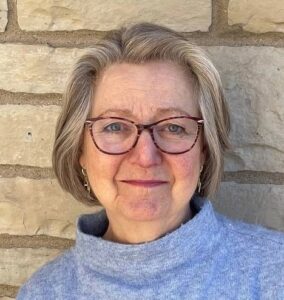 Thank you for the congratulations and for inviting me to tell my story. It’s been an amazing journey.
SERVING UP THE TRUTH tells the story of Amanda Knightly, known as the Deli Lady of Oak Hills, for her top-notch customer service behind a suburban Chicago grocery store counter. Stopping at her bestie’s coffee shop before heading to her shift, Amanda is stunned when police burst in. She’s shocked when they arrest the barista, who’s a close friend of her son, for a young woman’s murder. Convinced he’s innocent, the Deli Lady starts sleuthing while slicing. She uses her ears and eyes to pick up clues from customer chatter that could point to suspects the police overlooked. When things get as stinky as three-week-old-potato salad, and her list of suspects have all been crossed out, can Amanda serve up the truth before it’s too late?
My inspiration for SERVING UP THE TRUTH came from a community college class. After a long career in technology, a literary writing class was a must-do for this fledgling author. Our final assignment called for writing a short story in any genre, bringing in the five senses and some kind of conflict. I headed to my local coffee shop to ponder how to start.
Sipping my favorite latte, it hit me. The coffee shop had all five senses: the smell of coffee aromas, seeing customers, the taste of my latte, touching the hot cup, and hearing customer chatter.
Now I needed conflict. I decided there’d be an off-page murder. The police would burst into a coffee shop and arrest the barista, right in front of my protagonist. Believing it was an unjust arrest motivates my protagonist to leap in and find the true killer. 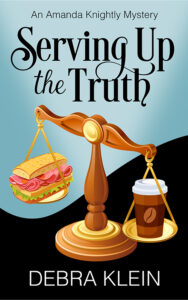
I wanted my protagonist to be a total newbie at sleuthing, and someone who people would feel comfortable talking to. So, I conjured up Amanda Knightly, a deli clerk, well-known in the town as the Deli Lady. She usually ignores the gossip that drifts over the counter. But now it could be the key to clues that would lead to other potential suspects. She starts out on a roll but soon hits her first bump.
I made sure Amanda was a real person, with the highs and lows of family, friends and everyday life. She wasn’t going to let anything stop her from finding the true killer, no matter how many times it turned her world upside-down and back.
When I turned in my short story, the instructor gave me a big thumbs up. She said it’d be a great start for a cozy mystery novel. I was thrilled. Thus, SERVING UP THE TRUTH was born.
Tell us about your protagonist’s personality and why she was so motivated to investigate a murder.
Amanda earned her Deli Lady reputation delighting customers with her can-do work ethic and friendly demeanor. Her flexibility and smarts let her successfully work through all situations. When we meet her, the job is starting to lose its shine, but she needs the paycheck. After witnessing what she believes is a false arrest for a murder, her can-do work ethic kicks in. Idle customer chatter could point to potential suspects. Her Deli Lady persona could open doors and mouths.
She grows personally when Amanda’s bestie asks her to temporarily step in as manager of the coffee shop. She cleverly comes up with a plan to help her friend, continue hunting for the true killer and still keep her deli job, all at the same time. Finding the solution ups her confidence, proving to herself she can tackle whatever she puts her mind to.
When none of her potential suspects pan out, Amanda’s can-do work ethic won’t let her give up. She steps on the gas – literally –and won’t stop until the true murderer is found.
You had a 35-year career in IT. What led you to decide to write a cozy mystery?
I thoroughly enjoyed my 35-year IT career that started at Sears in Chicago’s Sears Tower, now Willis Tower, with a bonus of great views. My career went the full gamut, from programmer to project manager. I’m a techie, but I always enjoyed writing with a pen or keyboard, and finding the right words to craft the best sentence, whether in personal or technical documents.
But I itched to write a novel. Retirement provided me with opportunity. As a reader of many genres, I wasn’t sure where to start. The decision was made for me in the writing class I talked about earlier. That started my writing journey and my first cozy mystery.
Interestingly, although they seem like total opposites, I believe there’s a strong similarity between IT and writing.
A programmer tests, tests again, and keeps testing until the outcome is perfect. Missing even a slight error could trigger a catastrophe.
An author edits, edits again and keeps editing until their book is perfect. True, it’s usually not the same catastrophic risk if something is missed. But it can affect the success of their book if that slight mistake turns into a big red flag for reviewers and readers. And no one wants that.
For those thinking about writing a mystery, what steps did you take to develop your mystery fiction writing skills?
When I signed up for a writing class at the local community college, not only did it start me on my first novel, it was the start of a writer’s critique group with six of my classmates. Members have come and gone, but we continue to have a core group that meet-up locally. They have been my rock.
I soon joined Sisters in Crime, the Chicagoland and Guppies chapters, Mystery Writers of America and Authors Guild. They’ve all been a great resource for meeting other writers and learning about craft, marketing, and the writing business. I also attend as many mystery writing conferences as I’m able. The relationships and connections I made at professional events, groups and classes were invaluable. I couldn’t have published my debut cozy novel without their part in my development as a writer.
I’ve found writing short stories to be a great learning tool. I can put my head around 3,000-5,000 words, with a beginning, middle and ending, a lot easier and faster than a 75,000-word novel. It also gives me the opportunity to write short stories in multiple genres. That paid off when my first published work in an anthology was a fun ghost story, featuring the Chicago Bears football team. Short stories are a good way for me to take a break from my novel and still keep writing.
Even as an Indie publisher, I found writing a summary, a query letter, and short pitch helped me market my book. I was surprised how many times I’ve continued to use them for submittals, conference signups and general information. I always keep them up-to-date and handy!
I think many aspiring authors will be inspired to learn that it took you eight years to complete writing and publishing your novel, but you got there! Can you talk about your journey to producing a publishable novel, which has garnered such positive reviews?
When I first started writing my novel, I quickly learned it would be much harder than I ever thought. During my first few years, I revised many drafts and joined local mystery writer groups and activities. This was pre-pandemic, when gatherings were in person. Thank goodness Zoom appeared the same time the pandemic started so meetings and events could continue online.
At the three-year mark, I had a completed manuscript and heeded the suggestion to have a professional editor review it. I found my editor through MWA Midwest. I quickly found out I needed more than one pass. We have worked together ever since. She is my hero!!!!!
My editor recommended that I get better educated on police work. Attending hands-on sessions presented by the local police department was eye-opening. It also added to my timeline. But I learned it’s very important to be educated by those in the profession.
At the seven-year mark, my manuscript was ready. I made the rounds of agent queries with no response. Knowing if I continued trying the traditional route, it’d be at least one to two years at a minimum before I’d be published. With my project management background, I decided to Indie publish. I found my wonderful cover designer and formatter through the Guppies and my sharp-eyed proofreader through a referral.
I had one more step. I splurged on a professional review. I received their very positive write-up just before Christmas. It was my best gift. Extracts along with two great blurbs from my Sisters in Crime Chicagoland chapter buddies are on my back cover and in all of my marketing.
Year eight, I held my very first published book in my hands. I was thrilled. And very thankful I didn’t go into a ninth year. (smile)
I know that you’re a lifelong lover of Chicago and a resident of one of its suburbs. How important was evoking the setting to you in creating your story?
“Write what you know” became my mantra for SERVING UP THE TRUTH from the first day. Sitting in my local coffee shop bringing together the story, I could envision the fictional Oak Hills with the same layout as my town. Once I got started on the novel, I expanded the fictional Oak Hills setting to include nearby suburbs. Once published, I found that to be a great draw for local book signings and book clubs. They loved to guess the real-life stores, restaurants, etc. that I had cast as fictional in my Oak Hills setting. No surprise, my next book in the series will also be set in fictional Oak Hills, and with more real-life sites cast as fictional.
I love that you said that “walking into a bookstore is like stepping into a chocolate shop” where you “want one of each!” Who are some authors who’ve especially inspired you?
Agatha Christie, William Kent Krueger, Erik Larson, Sara Paretsky, the Nancy Drew writers, Virginia Evans, Shelly Read, and Fiona Davis have all inspired me. I’m also including all the mystery authors I’ve met through Sisters in Crime and MWA, who are way too many to list here!
What is your writing process like?
I follow the well-known philosophy: Get it down, Get it right, Get it pretty.
In “Get it down,” I start with a one-to-two-page synopsis of the general storyline, even for short stories. Once I understand the whole story, I plan out the characters, the main plot points, and the places where it happens. Then I dig into the action and emotions. The outcome is a loose draft(s).
In “Get it right,” I focus on the content chapter by chapter to start. I identify and fix holes, ensure my characters are captivating and true, and make sure the story makes sense and is intriguing. Then I work through the full manuscript many, many times. It’s also at this stage that I work heavily with my editor. The outcome is a solid manuscript. This is where I spent the biggest chunk of the eight years.
In “Get it pretty,” I focus on the flow so it’s a smooth read. I read each chapter in different ways: first using text-to-speech, then out loud, then printed, and lastly on my phone to check if I like the story’s flow. Repeat the process as needed. I worked with my professional proofreader on the final pass. My book was finally ready to be published!
What’s next for you writing-wise?
The second book in the Amanda Knightly Mystery series is in the “Get it down” stage. It needs a lot more work before moving to the “Get it right” phase. No date yet, other than I hope to have it out sooner than eight years from now. (smile)
I also signed up for an upcoming short story contest, where the genre, subject and character are pre-determined. The genre can be anything from Fantasy to Romance to Historical to Comedy and more. I’m looking forward to the challenge!
Anything else you’d like to add, or wish I’d asked that I didn’t?
I’m very grateful for the advice from seasoned writers to set up my author business early on.
These are the four basics I set up as a new author.
- I opened a separate business account that included a credit card. It separated personal from business transactions for income tax purposes beginning that first year.
- I claimed my domain name and author email account address so they’d in sync and couldn’t be taken by someone else. Plus, it was an easy way to keep my personal and business emails separate.
- Once I had my domain name and author email in place, I setup a very basic website with a high-level blurb of my book, my picture, my story and a sign up for reader’s email addresses. It was ready for future updates.
- I ordered very basic business cards with the generic caption “Mysteries and More” with my picture, my author email and my website. They came in very handy when I first began introducing myself as a new author to contacts. Plus, it made me feel like a “real” author when I handed out my card.
In summary, start with the basics as you begin your author career. You’ll be glad you did!!
BIO:
Debra Klein is a lifelong Chicagoan, who loves everything about the city and the people within it. She serves on the board of her Sisters in Crime local chapter, is a member of Mystery Writers of America and the Authors Guild. A long-time reader across all genres, for Debra, walking into a bookstore is like stepping into a chocolate shop – she wants one of each!
BUY/CONTACT LINKS:
Email: DebraKleinBooks@gmail.com
Congratulations, Debra!
Thank you, Mary Lee. I was delighted Lynn invited me to be on her blog.
Huge congrats, Debra! Of course I love Serving Up the Truth! Looking forward to Book 2!
Thanks, Lisa. I’m focused on getting Book 2 rocking and rolling!!