Award-Winning Debut Author Jennifer K. Breedlove Listens to “the Flow and Cadence of the Words”
What a delight to interview an award-winning debut author who’s spent her life making music and approaches her fiction with a musical ear. Below she talks about her journey to writing MURDER WILL OUT.
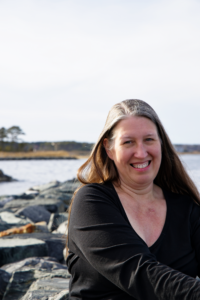 First off, a huge congratulations for the release of your debut novel, MURDER WILL OUT. Can you share with our readers a bit about the novel and what inspired it?
Thank you so much! The book is about a shy graduate student musician who returns to Little North, a fictional island off the coast of Maine, after the death of her estranged godmother. Willow’s godmother Sue was the owner of Cameron House, a historic (and haunted) Maine mansion, victim of what appeared to be a tragic accident—the second heir to the property to die over the space of just a few months. Willow finds herself trying to juggle dealing with her own grief and memories, figuring out who is getting rid of the Cameron House heirs one by one, and hopefully not becoming the next victim herself. The living people on the island aren’t much help—but fortunately, the mansion is full of ghosts. And they have…opinions.
The inspiration for the plot of this book came from my mom, actually—she is a retired chemistry professor and now a potter and ceramic artist in the same area of Maine where the book is set. When I told her I was thinking about writing a mystery novel, she pulled together both her areas of specialty and, without batting an eye, came back with a solid story idea involving poisons and pottery. I can’t say more than that, because her proposal became an element of the plot of MURDER WILL OUT.
You hold degrees in piano, choral conducting, and theology and have a distinguished career in music. What led you to decide to write a mystery novel? 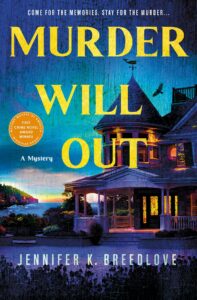
There’s a certain irony that I always wanted to be a writer but wound up in music as a “more secure” profession! I moved to Chicago after grad school, where I got my first full time job as a church musician; I immediately fell in love with the city, settled in, and built my career here. Even then I wrote a lot—first magazine articles, then resource guides for other church musicians, and eventually a few books, but all in church music and music education.
At some point I decided to make time for writing fiction again, but juggling my various jobs, parenting, and making space for fiction writing and study was a major challenge, and it was slow going. In the end it was the pandemic that cleared the path for me; with in-person musicmaking shut down, I needed to do something to feed my creative side, and suddenly for the first time in my adult life I had time! I first started a really complicated novel that soon buckled under its own weight; I liked the idea, but it was much too scattered, and I couldn’t pull it together. In hindsight, I think I was trying to write a Great Literary Work, rather than the kind of book I’ve always turned to for fun —once I decided to take myself less seriously and just tell a good story, things were much better (though I hope to return to that other novel someday, maybe without all the self-imposed existential pressure this time).
I loved that you set your novel in Maine, the setting for my first novel as well. Can you talk about the importance of setting in your work?
My family has been visiting Downeast Maine since I was tiny; we camped there every summer as kids. Once my brothers and I were grown, my parents bought a little log cabin on Mt. Desert Island and became legal residents. Somewhere in an old box is a thick spiral notebook containing the unfinished “novel” I wrote one summer during our vacation when I was maybe thirteen, mostly a retelling of our various adventures that July. I think I always knew I would set a story there; it’s my favorite place on the planet. The ocean, the lighthouses and bell buoys, the granite coast, the fog…it speaks to my soul in a deep way. And the people in my parents’ circles are wonderful—there’s this down-to-earth pragmatism and self-sufficiency, a rich sense of community, and a refreshingly dry sense of humor.
You’ve written nonfiction books and articles, but fiction writing is a different kind of writing challenge. What steps did you take to hone your fiction writing skills?
That was a challenge for me! I hadn’t done enough deep study of story structure, so my narratives tended to get to a certain point, like my Great Literary Novel, and then collapse. With the encouragement of my daughter (an aspiring writer), I read everything I could find about the architecture and shape of novels—there are a lot of story structure theories out there! I happened to catch a webinar with a company called Pages and Platforms; Anne Hawley and Rachelle Ramirez’s “Story Path” approach just clicked for me and gave me the tools I needed. I highly recommend them—the full course is massive, but they have smaller courses for individual story types, and they are frequent presenters at online writing summits. I also lean heavily on K. M. Weiland’s Helping Writers Become Authors materials; she’s got some wonderful resources.
A related question: What advice would you give to someone who aspires to write a novel?
Well, in a related answer, I would say: pay attention to story structure! It was my missing piece, and once I unlocked it, everything changed. It’s worth the time and effort.
I would also suggest, while writing early drafts, not to worry about over-writing, and not to worry about “wasting” words. I think of it like practicing piano: all the scales, all the studies, all the pieces I learned that I never performed in recital—they were all preparation for something else, and they made me a better musician. I often hear well-meaning advice that says, “Be careful where you start your book; many writers start much too early and include reams of backstory that readers don’t need.” While I agree that you probably don’t need all the backstory in your final book, I’m a big fan of writing it anyway. You can cut it later. Sometimes you need to start before the story begins to figure out where the story actually does begin.
Of course, then you also can’t be afraid to cut the words your story doesn’t need. It’s just part of the process. Remember: in this age of word processers and cloud memory, we never have to “kill our darlings.” Our darlings, when removed from the manuscript, can go sit in a nice comfortable file folder sipping cocoa and nibbling snacks until a day comes when we might need them again, or live forever in happy retirement. No writing is ever wasted. The final product isn’t really the point; the writing is the point.
You are also a prolific composer of choral music. What have you found are the similarities as well as differences in your approach to composing music and creating fiction?
This is a great question…It’s interesting, because most of my musical compositions are small pieces, and I have a really hard time writing short stories; on the other hand, while I love writing long form fiction, I have never managed to create a large choral work.
I think the biggest similarity for me between the two disciplines—and I don’t think I was conscious of the parallel till you asked this question—is that my process of listening for the line and flow is essentially the same whether for a musical line or a string of words. My final editing process is largely about listening with a musical ear to the cadence and rhythm of the words and making sure they flow effortlessly for the reader—getting them to “sing,” if you will. The best melodies don’t draw attention to themselves, they just Are; the same, I find, is true for a good piece of writing.
It’s a work in progress. I can go about daily life fairly content with my prose, and then I’ll read Daphne DuMaurier or Shirley Jackson, and I realize how far I have to go. Rebecca is a master class in singing prose.
You have a busy career as a music faculty member at Loyola University, as well as serving as an assistant conductor for the Chicago Symphony Orchestra Chorus. How have you managed to fit in writing time and pen an award-winning first novel?
Both my kids are in college now; with an emptier nest, I have a little more flexibility to find and make the time. As for this novel —as I mentioned, I wrote the first draft during the pandemic, when most of my other jobs had shut down; all my teaching was over Zoom, and the CSO Chorus was out of commission for a good while. There were a lot of aerosol studies done and articles written in those early months (I wrote a few of them!); since group singing posed a particular danger area for spreading the virus, our return to rehearsing and performing had to be cautious. Once a fuller schedule started up again, I had much less time, but I found myself unwilling to let go of the protected space I’d made for writing—I loved it too much. Even with my schedule back to “normal,” my various jobs run in cycles, with heavy times and lighter times; I’m learning to take advantage of the space between concerts or school breaks to carve out more writing time.
What’s next for you writing-wise?
I am definitely not done with Willow and the Cameron House ghosts—or maybe I should say they are not done with me. I’m currently working on the next book and exploring what might happen over the next few years on my fictional island.
Anything else you’d like to add, or wish that I’d asked that I didn’t?
Nope! These were really wonderful and thoughtful questions—thank you so much!
BIO:
JENNIFER K. BREEDLOVE is a Chicago area composer, conductor, author, editor, and educator. A frequent visitor to Downeast Maine since childhood, she has an enduring affection for the wild beauty of the coastal islands and the warmth of the people who make their homes there. Her debut novel, Murder Will Out, won the Minotaur Books/Mystery Writers of America First Crime Novel Award.
Learn more about her work and contact Jennifer at: https://www.jkbreedlove.com/
Purchase link (this is to MacMillan with links to various sellers): https://us.macmillan.com/books/9781250382610/murderwillout/
Great interview, Jennifer! Your book sounds great – Maine, murder, and ghosts? What’s not to love. I LOLed over the part about your darlings enjoying a comfortable retirement.
Just finished Murder Will Out and looking for what’s next! This story hit all the buttons of the perfect read…history, mansions, murder, ghosts and more! Glad to hear there will be more Willow stories, but honestly, I will read any story Ms. Breedlove has to offer. Her writing is just that good!