Elle Jauffret Tackles Issues of Identity in COSPLAYED TO DEATH
 We often talk about how the best mystery authors tackle issues that go way beyond “whodunnit.” Elle Jauffret is a great example, as she releases the second book in her Suddenly French mystery series:
First off, congratulations on the highly anticipated release of the second book in your Suddenly French mystery series, Cosplayed to Death. Can you share with our readers a bit about the book and what inspired it?
Thank you so much! Cosplayed to Death takes Claire Fontaine back to her hometown of Caper Cove during a major international surfing competition. When a pro surfer is found dead and later a beloved cosplayer from the Vandstam TV show is murdered, Claire finds herself investigating two seemingly unrelated deaths while juggling her new identity as a caterer and dealing with an online troll who’s destroying her reputation.
The inspiration came from my fascination with how people construct and reconstruct their identities—whether through cosplay, body modification, or career changes. The competitive surfing world and the cosplay community both offered perfect settings to explore themes of authenticity, transformation, and the pressure to be “one thing.” I was also intrigued by the darker side of online harassment and how social media can be weaponized against people who don’t fit neatly into societal boxes.
In what ways has your protagonist, Claire Fontaine, grown and changed since we first met her in Threads of Deception? 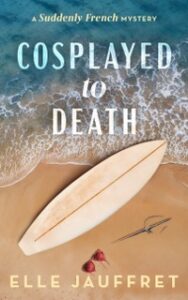
Claire has grown significantly. In Threads of Deception, she was still reeling from the explosion that destroyed her law firm and struggling to accept her Foreign Accent Syndrome. She was sort of hiding in Caper Cove, uncertain of who she was anymore. In Cosplayed to Death, Claire is actively building a new life rather than just recovering from her old one. She’s embracing her dual identity as both chef and lawyer, refusing to let others (like the troll Fireinyourmouth) force her to “pick a lane.” She’s more confident in her investigative abilities, working alongside Detective Torres rather than against him. We also see her grappling with survivor’s guilt when the FBI reveals why she survived the bombing, and she discovers new evidence about her missing sister Aurora. Claire is learning that identity isn’t about choosing between different parts of yourself, but that it’s about creating a life big enough to hold all your pieces. 
The setting of Cosplayed to Death has shifted to the worlds of cosplay and competitive surfing in San Diego County. What role does the change in setting play in Claire’s character arc?
The dual worlds of competitive surfing and cosplay mirror Claire’s internal struggle with authenticity and identity. Both communities grapple with performance versus appearance and genuine self-expression, forcing Claire to confront her own questions: Can she be both a lawyer and a chef? The influx of thousands of visitors makes Claire examine what “belonging” means: she’s a local who sounds foreign, someone who left but came back. Characters like Ricky, who pays for a position on a team, and Renée, who undergoes extreme body modifications to embody her character, push Claire to consider how far people will go to gain approval or feel authentic.
Claire’s French Accent Syndrome in Threads of Deception allowed you to explore how society reacts to people who are perceived as “different,” a major theme of the book. In Cosplayed to Death, what would you say is the overriding theme that you are exploring?
The overriding theme is identity fluidity and the rejection of false binaries. Throughout the book, characters are forced to choose between seemingly incompatible identities: lawyer or chef, sounding French or American, victim or survivor, traditional beauty or authentic self-expression. Claire faces constant pressure to “pick a lane”— from the online troll who attacks her for being both a lawyer and chef, to clients who cancel because they can’t reconcile her accent with being American-born. Even the people involved in the crimes are shaped by society’s rigid identity expectations; their actions stem not from simple villainy but from deep conflicts over selfhood, visibility, and belonging.
The book argues that we contain multitudes— we can be lawyers and chefs, survivors and thrivers, rooted in multiple cultures simultaneously. The most dangerous thing isn’t being hard to categorize; it’s living in a world that punishes people for defying simple categorization. Claire’s triumph isn’t choosing between her identities but refusing to choose at all. 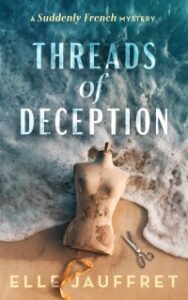
Threads of Deception was a highly lauded, award-winning debut novel. Some authors whose first books have made a big splash have said their sophomore novels were especially challenging to write, in part because of the high level of expectations their first novel engendered. Was that your experience, or did you feel a greater ease and confidence in penning the second book of your series, since the first was so well received?
I’m genuinely grateful for the positive response to Threads of Deception, though I’m not sure I’d call it a “big splash.” Still, the support from readers and the recognition it received gave me a sense of confidence going into book two. That said, most writers (myself included) carry some fear of disappointing readers, especially after a debut. We want to grow creatively without losing what people connected with in the first place. Luckily, I had already mapped out loose outlines for books two and three when I sold the series, so I wasn’t facing the blank page from scratch. In fact, the first book was the most challenging: it taught me to rein in my natural tendency toward complexity and focus on stronger dialogue and tighter pacing. With Cosplayed to Death, the reception from advanced readers has been extremely positive, one even called it “the epitome of the modern cozy.” That feedback, along with reader encouragement, made me feel freer to explore more layered plotting and dive deep into two very Southern Californian communities: surfing and cosplay.
When I interviewed you about Threads of Deception, I loved that you said that you were inspired by Stephen King’s comment: “Amateurs sit and wait for inspiration. The rest of us just get up and go to work.” What other advice would you give to aspiring writers?
- Give yourself permission to write badly. Your first draft’s job is to exist, not to be perfect.
- Read widely in and outside your genre. Each genre teaches you something about craft. Reading outside mysteries has helped me understand character development, atmospheric writing, and how to handle sensitive topics with nuance.
- Find your writing community (in person or online). Organizations like Sisters in Crime, Mystery Writers of America, and International Thriller Writers can be invaluable as they often provide free workshops and classes to their members. They can also help you find critique partners (receiving feedback from fellow writers who understand the mystery genre will make you a better writer.)
- Remember that writing is art, but publishing is a business. Learn about the industry, understand contracts, build your platform. Above all, protect your writing time fiercely.
- Write what scares or bothers you. If a scene, character, or theme makes you uncomfortable, that’s often where the most powerful writing lives. Claire’s struggle with her accent and her place in the world was difficult to write, but it’s what gives her depth and makes her relatable.
A related question: Authors today are expected to do the lion’s share of their own marketing. How do you balance the demands of creating as a writer and marketing?
I don’t think of marketing in the traditional sense. Instead, I focus on sharing what genuinely excites me, whether it’s research rabbit holes, travels, or behind-the-scenes story inspiration. If I’m genuinely curious or lit up about something, chances are someone else will be too. That kind of sharing feels more like conversation than promotion. So I prioritize authenticity over constant presence. I’d rather post less frequently but share genuine insights about my book and my life experience than maintain a frenetic social media presence that exhausts me. I usually post 1-3 times a week (more frequently in the weeks before my book release.)
To stay balanced, I batch marketing tasks. Rather than constantly switching between writing and promotion, I dedicate specific blocks of time for content creation, especially around a book release and I “schedule” my posts.
I accept that I can’t do everything. I’ve made peace with not being on every platform, not attending every conference, not pursuing every marketing opportunity.
What’s next for you writing-wise?
I’m excited to continue Claire’s journey in the Suddenly French Mystery series—book three is almost complete! This installment digs deeper into the town’s hidden history and Claire’s past as she investigates her sister Aurora’s long-ago disappearance. The evidence Claire uncovers in Cosplayed to Death raises new questions that drive the plot forward and bring the “sister thread” to a dramatic conclusion. And yes—Claire’s slow-burn romance with Torres is reaching a turning point. Book three has been especially fun to write because it’s set in October, during Halloween, with a central theme of reckoning with the ghosts of our past.
Anything else you’d like to add, or wish I’d asked, but I didn’t?
I also want to mention the importance of representation in mystery fiction. Claire’s Foreign Accent Syndrome makes her an unconventional protagonist since she’s constantly misidentified, discriminated against, and forced to prove her identity. This reflects real experiences of many Americans who don’t “sound” or “look” like what people expect. By centering a character with a neurological condition that affects how she’s perceived, I hope to expand the conversation about belonging and identity in the mystery genre. Similarly, my research into cosplay and body modification inspired the character of Renée, whose physical transformation challenges assumptions about what identity should look like and who gets to define it.
Finally, I’d love readers to know that while this is fiction, the themes I explore—online harassment, wrongful convictions, survivor guilt, and familial grief—are rooted in real experiences. If Claire’s journey resonates with you, if you’ve ever felt pressured to “pick a lane” or been judged for defying easy categorization, please know that your story matters. The mystery genre is expansive enough to embrace all of us.
Thank you for these thoughtful questions and for your support of the Suddenly French Mystery series!
*************
Bio:
Elle Jauffret is a PenCraft Award winner and Agatha Award finalist and author of Threads of Deception, the first book of the Suddenly French mystery series. A former criminal attorney for the California Attorney General’s Office and jurist for the French Embassy, she now blends her legal expertise with a love of culinary and character-driven storytelling. Elle lives in Southern California and is a member of Sisters in Crime, Mystery Writers of America, and International Thriller Writers. You can find her at https://ellejauffret.com/ or on social media @ellejauffret.
Buy Link:
Threads of Deception and Cosplayed to Death – Available wherever books are sold. For links, check https://www.ellejauffret.com/Books
Contact / Website:
https://www.ellejauffret.com
https://ellejauffret.com/Contact
Instagram: https://www.instagram.com/ellejauffret/
Facebook: https://www.facebook.com/elle.jauffret
Thoroughly enjoyed this interview. The questions were specific and the answers were thorough.
Thanks, Candace. I really enjoyed interviewing Elle. She’s so articulate!
Thank you 🙂
Great interview. The responses were interesting and insightful.
Thanks so much, Tawn. I really enjoyed interviewing Elle.
Thank you, Tawn!